Visual Art 20
In the Saskatchewan Visual Arts Curriculum it is states that, "In Visual Art 20, students engage in artistic risk-taking with ideas, media and image development strategies. They explore ideas derived from various sources of inspiration including perspectives of First Nations and Métis people in Saskatchewan. Students use inquiry to create art in response to the work of national and international artists and experiment with a variety of art practices such as drawing, painting, crafting, printmaking, digital technologies, sculpture and installation. Students critique their own and others’ work and analyze factors that influence art-making globally. They investigate visual and interdisciplinary works that address diverse worldviews and evoke commentary on the human rights of Indigenous and various cultures. Student discover a range of opportunities to continue involvement in visual art related practices and careers." (Ministry of Education, 2019, p.2)
Visual Art 20 Lessons
Art Career ResearchIn this assignment, students research various art careers that they are interested in.
|

Formal Art AnalysisIn this assignment students watch a documentary about Damien Hirst’s interdisciplinary Relics exhibition and complete an art analysis of one exhibit.
|
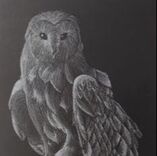
Spirit Animal Inspired DrawingIn this assignment, students learn about Indigenous spirit animals and draw animals that symbolically represent themselves using white pencil crayon on black paper.
|
Visual Art 20 Outcomes
|
Cultural Historical
CH20.1 - Investigate art works from around the world that address the human rights of Indigenous and various cultures. CH20.2 - Investigate how artists from around the world incorporate and manipulate media, form and content in interdisciplinary work. CH20.3 - 3 Investigate opportunities in arts communities and visual art-related practices and careers in Saskatchewan, Canada and the world. |
Creative/Productive
CP20.1- Engage in artistic risk-taking with ideas, media and image development strategies to achieve meaning. CP20.2 - Experiment with a variety of visual art practices (e.g., drawing, painting, crafting, printmaking, digital technologies, sculpture) to explore ideas derived from various sources of inspiration including perspectives of First Nations and Métis people in Saskatchewan. CP20.3 - Create art works, using various practices (e.g., drawing, painting, crafting, printmaking, digital technologies, sculpture, installation), that respond to diverse worldviews. CP20.4 - Use inquiry to create a work of art inspired by the work of national and/or international artists. |
Critical/Responsive
CR20.1- Identify and analyse criteria for critiquing and valuing various forms of visual art. CR20.2 - Analyze factors (e.g., inspiration, technology, culture, environment, events, government policies) that influence art-making practices around the world, past and present. CR20.3 - Reflect on, and critically respond to, self and peer art works in progress to enhance ideas and convey meaning. |